Know which flags are real before an engineer opens them
The vision models read the drawing. Turn on each layer to see which flags it removes, which it adds, and what that does to accuracy and cost across 300 drawing sets.
Built for Structured AI · the short version
Engineers trust a QA/QC tool only if its flags are real and it doesn't miss what matters, so every check needs measured precision and recall.
In this sample, all four layers together raise real issues caught from 75% to 84% and cut review time plus expected field cost from $311K to $208K per 100 drawing sets; the fixed rules alone lift the share of real flags from 51% to 66%.
Built on sample data. To make it real, I'd use A sample of flags with engineers' verdicts (confirmed or dismissed, with reasons), detection confidences, and the drawing sets' source format.
Who built it
Anirudh Devella, data scientist. Before this, in production:
- Cross-company technician benchmark behind raises and bonuses at Bluelight (YC)
- Forecast error cut from 13% to 8.3% at Bluelight (YC)
- AI Coach that raised engagement for 10,000+ athletes at Brandlete
- 150K leads scored to retarget direct mail at CoverRight
“I’d hire him again.” Alex Dixon, Co-founder, Bluelight (YC), managed Anirudh directly. Read it on LinkedIn
Generated in your browser from a fixed seed, so every visitor sees the same numbers.
Next step
My first week with your real data
- Score every check type's precision and recall on last month's engineer verdicts.
- Tune one confidence cutoff per check type on review time vs field cost, and replay it on past sets.
- Turn the most common dismissal reasons into candidate rules, replayed on confirmed issues before they ship.
You might also like
Similar case files
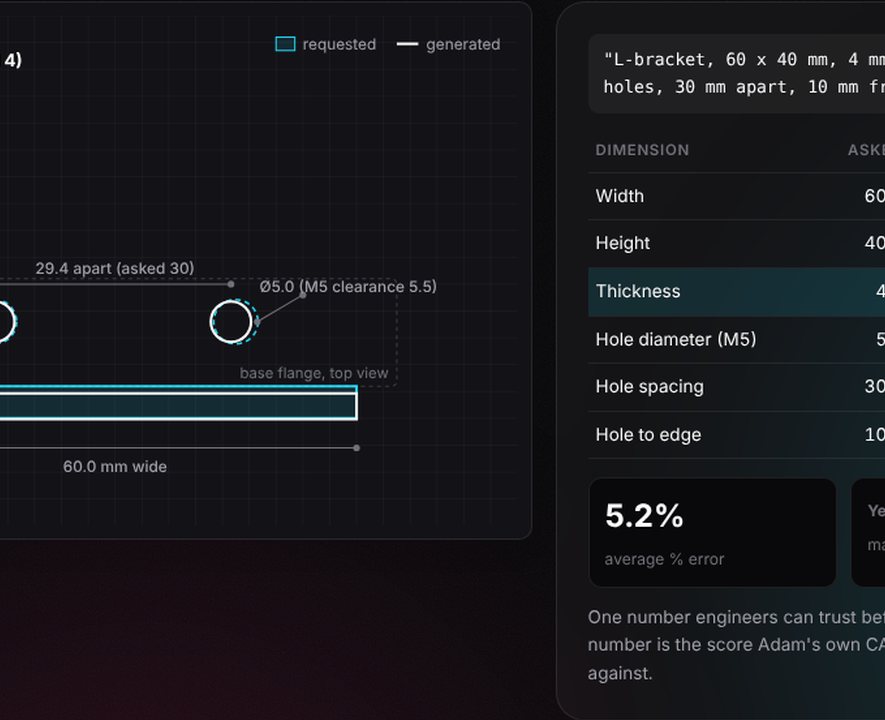 Adam · Case 011A number engineers can trustScores a generated CAD part on % dimensional error, then uses that score to route each request to the best model.Open the case →
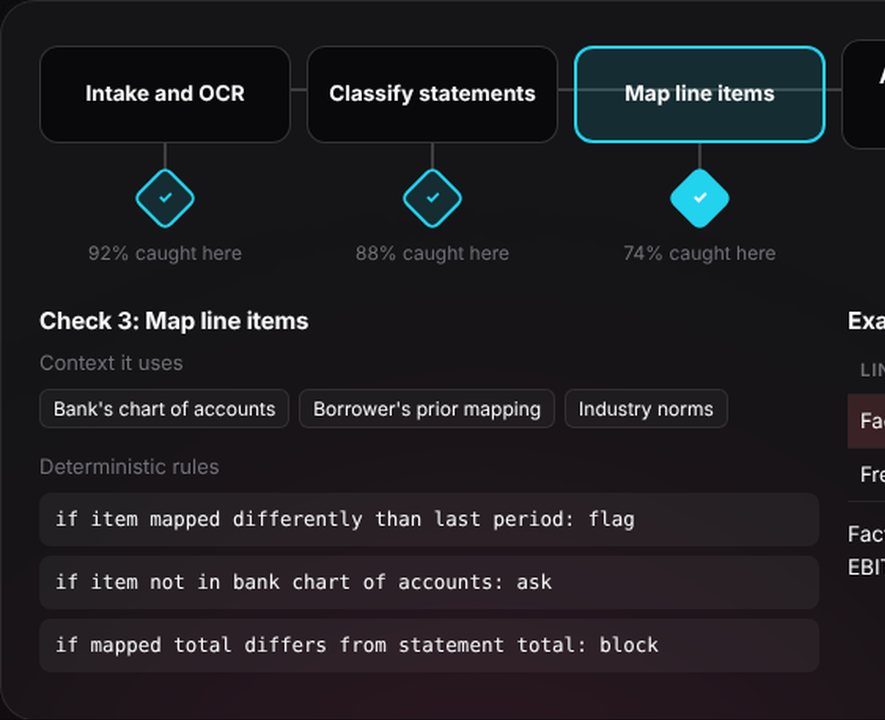 Accend · Case 008A check at every stepAn eval check under every step of spreading a financial statement, plus a track record for every reviewer.Open the case →
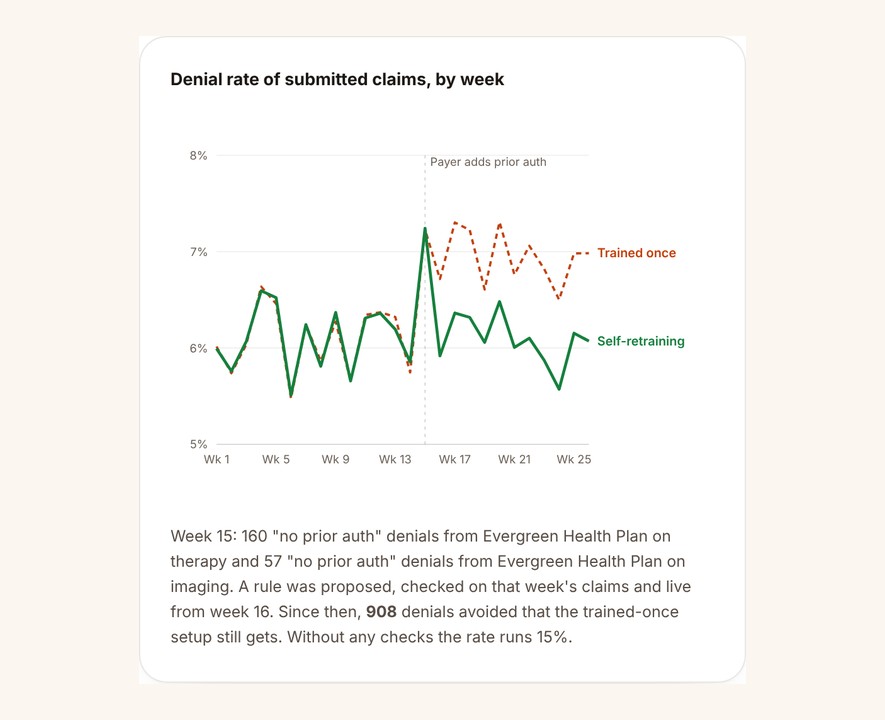 Camber · Case 020A claims pipeline, a denial model and checks that retrain themselves250,000 simulated claims from 40 clinics and 12 payers: a pipeline that reconciles every row, a denial model scored before submission, seven pre-submission checks, and a weekly loop that learns new payer rules and promotes a retrained model only when it passes a gate.Open the case →